Traumatic Birth Injury
Trauma During Birth
A baby suffers from “birth trauma” when they sustain any physical injury to their body during the birthing process. Mechanical forces like compression or traction during delivery can damage the baby’s nerve tissue, muscle tissue, or vital organs, resulting in a birth injury.

Compression and traction can be naturally occurring, like during contractions or when a child exits through their mother’s narrow birth canal. Sometimes, however, compression and traction can come from external forces, such as the misuse of delivery tools like forceps and vacuum extractors.
Free Legal Consultation
Birth Injury Lawyers
(888) 987-0005Our Birth Injury Lawyers are available to meet you in your home or the hospital.
The Birth trauma attorneys at Miller Weisbrod Olesky investigate the circumstances of your pregnancy and delivery to determine whether medical malpractice caused your child’s traumatic birth injury.
Types of Birth Trauma
Birth Trauma to the Head
Birth trauma to the head is the most common and often most serious type of trauma-related birth injury for a baby. This is because head trauma can often come with injuries to the brain, resulting in long-term cognitive and neurological disorders.
Birth trauma that affects the brain or skull can cause hypoxic-ischemic encephalopathy (HIE). This severe brain disorder is caused by oxygen deprivation (hypoxia or asphyxia) and reduced blood flow (ischemia) to the baby.

Babies born with hypoxic-ischemic encephalopathy (HIE) injuries face serious consequences like cerebral palsy, developmental delays, cognitive disorders, and seizure disorders. Additionally, head trauma can result in a number of different intracranial hemorrhages (brain bleeds) for the baby, including the following:
- Cephalhematoma
- Subgaleal hemorrhage
- Subarachnoid hemorrhage
- Subdural hemorrhage
- Epidural hematoma
- Intraventricular hemorrhage
- Intraparenchymal hemorrhage
Most neonatal intracranial hemorrhages are non-progressive, but may result in permanent physical and mental impairments, including cerebral palsy. Long-term physical, occupational, speech, and psychological therapies as well as the use of assistive devices may be necessary to help the child adapt to lifelong disabilities.
Trauma From Prolonged Labor
When a woman goes into labor, her contractions will temporarily restrict the flow of blood and oxygen to the child. When that period of oxygen deprivation is extended due to prolonged or arrested labor, it can cause hypoxic (lack of oxygen) or ischemic (lack of blood) brain injuries like HIE. Additionally, excessive contractions over a prolonged period can exert great amounts of force on the baby’s head. This can lead to head trauma during birth.

Healthcare professionals must act quickly in cases of prolonged labor to avoid the risk of head trauma and fetal distress. This may mean prescribing medications that soften the mother’s cervix and ease dilation, or it could mean using external tools like forceps and vacuum extractors to deliver the child. Each case will require a close assessment of the mother’s circumstances before deciding on the best course of action.
Nerve Damage
Excessive compression or stretching of the baby’s nerves during delivery can cause nerve damage. Some types of nerve damage resolve themselves over time, such as facial nerve damage caused by forceps. Other forms of nerve damage can cause lasting damage, such as brachial plexus damage that weakens or paralyzes arms or hands.
The most common brachial plexus injury is Erb’s paralysis or Erb’s palsy, which involves the upper nerves of the plexus. Palsy means muscle weakness or paralysis involving partial or complete loss of motor function. In the case of Erb’s palsy, the weakness or paralysis involves the shoulder and arm.
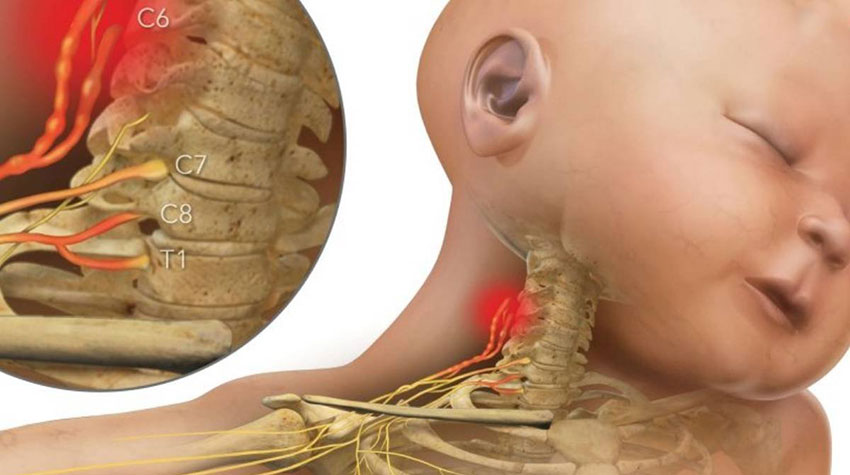
Damage to the Upper Trunk (C6) nerve in the brachial plexus can lead to paralysis in the hands and arms.
A baby with Erb’s palsy might be treated with physical therapy and medication at first. After six months of age, infants might have surgeries, including:
- Repairing damaged nerves through grafts, nerve transfers, and nerve decompression.
- Replacing damaged tissue with healthy muscles or tendons transferred from other parts of the body.
Other types of nerve damage sustained from birth trauma include:
- Phrenic nerve damage, which affects a baby’s ability to breathe.
- Spinal cord nerve damage, which can result in paralysis or death.
- Radial nerves, sciatic nerves, and obturator nerves damage caused during labor and delivery.
Babies with any type of nerve damage from birth trauma often require therapy, medication, and surgery.
Bone Injuries
Babies are sometimes born with broken bones due to birth trauma during delivery. The clavicle is the most common bone that breaks, and it usually heals with little treatment. Other bones susceptible to breakage include:
- humerus (upper arm)
- femur (large leg bone)
- facial fracture (especially around the eyes)
- skull fractures
Skull fractures are the most likely to cause long-term damage to the newborn. Broken bones, especially depressed skull fractures, have been linked to hypoxic-ischemic encephalopathy (HIE). Babies with HIE have a greater chance of having cerebral palsy, seizure disorders, cognitive disabilities, and developmental delays.
Traumatic Birth Injuries: Myths and Facts

Myth: Genetics cause birth trauma.
Fact: Genetics play a critical role in fetal development and can cause birth DEFECTS, but not birth trauma. Birth trauma refers to physical injuries sustained during the labor and delivery process, whereas birth defects are abnormalities that develop in utero. Birth defects can, however, increase a child’s risks for certain types of traumatic birth injuries.
Myth: A birth injury is only “traumatic” if it’s life-threatening.
Fact: A traumatic birth injury does not have to be life-threatening to count as birth trauma. In fact, many traumatic birth injuries can be fully recovered from without any long-lasting health consequences for the child. In this context, “trauma” refers not to the severity of the injury, but rather to the method in which the birth injury was sustained (i.e. compression and traction forces). Despite the terminology, birth trauma injuries can be minor in some cases.
Myth: Birth trauma is immediately apparent upon delivery.
Fact: Not all traumatic birth injuries are evident upon the newborn’s delivery. Certain types of nerve damage such as Erb’s palsy affect the arms and shoulders, which isn’t immediately visible in neonates. Newborns are unable to communicate certain symptoms of nerve damage like numbness and tingling, which sometimes leads to them going undetected. This is part of why neonatal monitoring and checkups are so vital to the child’s health and prosperity.
Myth: Birth trauma is irreversible.
Fact: While it is true that some conditions that stem from birth trauma injuries (cerebral palsy, for example) are irreversible, some conditions can be improved with proper treatment. For example, a broken clavicle bone during birth will usually heal with little treatment. Sometimes certain nerve damage, such as facial nerve palsy, can go away on its own over time. The highest concern for irreversible birth trauma comes with injuries to the head. This is because head injuries can hurt the brain and result in cognitive disorders and developmental delays.
Common Questions Parents Have About Birth Trauma
How Can Birth Trauma Affect a Child's Development?
The effects of a traumatic birth injury on a child can vary, depending on the type of injury and its severity. Physical injuries such as head trauma, bruises, or broken bones are often noticeable at the time of birth, but several developmental and psychological effects may take longer to present.

Oxygen deprivation is the most common cause of developmental delays and impacts to cognitive function. Multiple traumatic birth injuries can cause this, including prolonged labor contractions, umbilical cord complications during labor, certain maternal complications like uterine tachysystole, or the misuse of vacuum extractors and forceps.
These injuries can affect the flow of blood and oxygen to the baby’s brain, exposing them to the risk of developmental delays, cognitive disorders, and seizure disorders.
Can infants with birth head trauma have learning disabilities?
Yes. Trauma to the head during birth can happen for a variety of reasons, including the improper use of forceps and vacuum extractors or excessive contractions during prolonged labor.
Severe trauma to the head can affect the brain, which can spur brain damage and long-lasting developmental delays in children. Certain developmental delays can impact the way a child learns and processes new information.
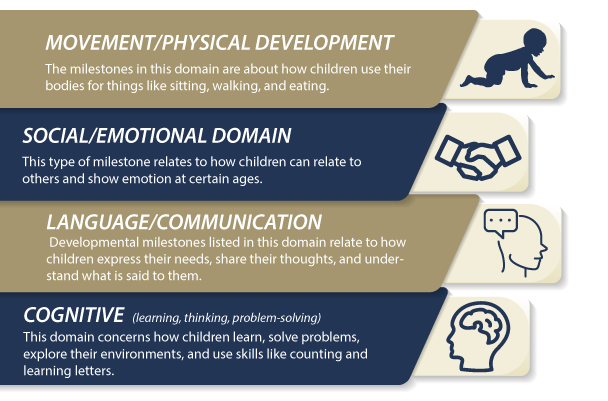
These developmental milestones have the potential to be delayed after a child suffers from a traumatic birth injury affecting the brain.
How can you help a baby who had birth trauma?
When a child experiences birth trauma, the most important thing is to identify it as early as possible. Healthcare professionals must know the signs to look for when the newborn is delivered and confirm that they aren’t showing any symptoms of birth trauma.
When the child doesn’t present any physical symptoms of birth trauma, abnormally high or low fetal heart rates can be an indicator. It’s important for healthcare professionals to stay alert for any issues, even when they aren’t immediately clear.
For newborns who have suffered from a traumatic birth injury, special treatment may be required after birth. They may need to be placed into a neonatal intensive care unit (NICU), where they can receive specialized care for breathing problems, bone fractures or other issues.
What are medical conditions caused by birth trauma?
The two most severe conditions that birth trauma can cause are cerebral palsy and hypoxic-ischemic encephalopathy (HIE). These are disorders that encompass a group of conditions affecting bodily and neurological functions.
Cerebral palsy and HIE are typically caused by a deprivation of oxygen or blood flow to the brain, but they can also happen as the result of blunt force trauma to the head.
Birth trauma can also cause certain nerve damage disorders like Erb’s Palsy, which can occur when the brachial plexus is injured. This can cause paralysis in the arms and hands. Other traumatic birth injuries can cause nerve damage and paralysis in other parts of the body such as the face (facial palsy) or the legs (paraplegia).

Head trauma at birth can result in intracranial hemorrhaging (brain bleeds), which can have multiple detrimental effects to the child’s wellbeing. The most common medical conditions arising from brain bleeds are cephalhematoma (a pool of blood between the scalp and the skull) and caput succedaneum (swelling along the newborn’s scalp).
Other medical conditions include bone fractures and fetal distress.
Do babies remember trauma?
While it is unlikely that babies will have a visual memory of birth trauma later in life, the body can internalize traumatic events and then have a physical reaction later in life.
In the context of birth trauma, not emotional or psychological trauma, a child is unlikely to have memories of their own birth injuries during delivery. However, their life trajectory can be substantially altered with the onset of a physical or mental condition that stemmed from a traumatic birth injury, which may be a source for mental or emotional anguish in their life.
While research suggests that babies can show symptoms of trauma at birth, a medical consensus has yet to be reached regarding the long-term effects of processing these events in memory.
Trauma Caused by OB-GYN Malpractice
OB-GYN stands for obstetrician-gynecologist. These are doctors who specialize in women’s care. Obstetrics refers to the care of pregnant women, their unborn children, and any treatment they may need during pregnancy, during labor, or for the post-partum period after giving birth.

Gynecology more broadly refers to the care of women’s reproductive organs: the uterus, ovaries, cervix, fallopian tubes, or the vagina. Other women’s health issues, including menopause, hormone problems, and struggles with infertility, would all fall under the care of an OB-GYN.
In most cases, an OB-GYN is the type of doctor who will deliver a mother’s child. They carry a heavy responsibility in ensuring the baby avoids birth trauma injuries. When an OB-GYN’s medical errors do result in birth trauma, the affected family may have a case for medical malpractice.
What is Obstetrical (OB-GYN) Malpractice?
Like all other medical professionals, OB-GYN doctors are held to a certain standard of care. This means that there are generally accepted healthcare practices they are expected to follow when treating their patients. If a doctor were to “breach” this standard of care in any way, such as not conducting proper tests or failing to catch signs of a disease, it can constitute as medical malpractice.
Types of Obstetrical (OB-GYN) Malpractice
Obstetrical malpractice can have dangerous consequences for an expecting mother and her child. It can occur at any point during the childbearing process, from the first ultrasound all the way to after the child has been born.
During Pregnancy
The most common types of OB-GYN malpractice during the prenatal period include:

- Missed diagnosis of pregnancy complications such as gestational diabetes or preeclampsia.
- Improper administration of medication due to negligence OR a misdiagnosis.
- Failure to identify abnormalities in fetal formation or other causes for concern.
During Labor & Delivery
The most common types of OB-GYN malpractice during labor and delivery include:

- Failure to monitor fetal distress during labor.
- Delaying a critical C-section birth during prolonged/arrested labor.
- Misuse of delivery instruments like forceps and vacuum extractors during delivery.
- Prolonged wait time during labor in the event of an emergency such as hemorrhaging, uterine tears/ruptures, placental abruption, or complications.
Postpartum
The most common types of OB-GYN malpractice during the postpartum period include:

- Mismanagement of postpartum complications like infection, blood clots, or hemorrhaging.
- Failure to address concerns regarding breastfeeding and other issues regarding neonatal care.
Infant Wrongful Death
A child’s death is one of the most heartbreaking losses a parent can endure. While only a nightmarish hypothetical for most parents, infant mortality was a devastating reality for the parents of more than 20,000 infants who died in 2022, according to the CDC.
Parents grieving the loss of their child from neonatal mortality (death within the first 28 days of birth) or infant mortality (death within the first year of birth) deserve answers as to how it happened, and the extent to which negligence or other medical errors played a role.

Medical negligence occurs when doctors or other healthcare providers make decisions that fall outside of their standard of care. To win a birth injury malpractice lawsuit, it must be proven that the healthcare professional breached this standard of care by making decisions or errors that directly contributed to the infant’s death.
This process typically involves the following steps:
- Establishing a standard of care: The birth injury attorney must prove that the defendant (whoever is being sued) owed a duty of care to the infant to give them proper medical treatment.
- Establishing a breach in that standard: It must be proven that the actions or lack of actions made by the defendant fell below the standard of care expected from someone in their position in a similar situation.
- Proving causation: The attorney must prove how the defendant’s choices played a significant role in causing the infant’s death.
- Demonstrating damages: The attorney must prove how the defendant’s actions resulted in damages for the plaintiff (you). In cases of infant wrongful death, damages can include hospital bills, funeral expenses, or emotional distress. Loss of support or companionship can also count as a damage.
Determining Fault in Birth-Trauma-Related Lawsuit

The attorneys, nurses, and staff of Miller Weisbrod Olesky understand that parents of children who have suffered from birth trauma feel overwhelmed. This is why we strive to ensure every client has the full attention and support of our trained, compassionate team of professionals.
We don’t just offer compassion; we offer a comprehensive process to help you discover whether your child’s birth injury, HIE, cerebral palsy or brain injury was caused by a medical error.
- Step 1: Case Review Team (Intake): During your first contact, you will speak with one of our birth injury-trained intake team members. Each member is a nurse or works closely with our legal nurse team. Our intake team member will gather all the facts you have regarding your child, the birth of your child, and all concerns you have about the birth process.
You will not be required to tell us what you think was done wrong; that is our job to find out. Otherwise, please feel free to tell us everything you feel and know. - Step 2: Gather Medical Records on You and Your Child: It usually takes six to eight weeks to retrieve medical records. As soon as they arrive, our nurse consultants and nurse-attorneys thoroughly review them. We then review each case at a birth injury case review meeting. Firm partners, various birth trauma attorneys, and our entire legal nurse and legal nurse-attorney team all attend this meeting.
- Step 3: Consult With Medical Experts (RNs & Nurse Attorneys): At this point, we decide whether the medical records support a potential birth injury negligence or birth injury malpractice lawsuit. If they do, we begin working with medical experts necessary to pursue a birth trauma lawsuit.
These experts include obstetricians, neonatologists, pediatric neurologists, pediatric radiologists, nursing experts, life care planners, and economists. In some states, we must get official written reports back from these experts before filing a lawsuit.
This entire medical record review process may take as long as six months to complete. We use this time preparing to manage all the potential issues that may arise after the experts have reached their medical conclusions. - Step 4: Review Case With a Dedicated Birth Injury Attorney: If we decide to take your case, you will meet with a professional birth trauma attorney and other team members. Our dedicated birth injury attorneys will walk you through our findings, what the medical experts found, and how the litigation process will work.
- Step 5: Attorney Contract/Retainer Process: We will have you sign our firm attorney contract that officially hires us to represent you. You will also sign medical authorizations so we can gather additional medical records covering:
- Your prenatal care
- Your labor and delivery
- Your child’s neonatal care
- Follow up visits with pediatricians and other specialists
Once again, you will not pay any attorneys’ fees or expenses during this process. You will never owe a fee or reimbursement of expenses unless we make a successful recovery for you and your child. We believe in taking care of our clients during each step of this process. Please know that we are here to listen and help during the entire journey from case review all the way to a potential lawsuit.
Finding the Best Birth Injury Attorney

There are a variety of factors to consider in the search for the best birth injury attorney for your case.
Location
When finding the right birth injury attorney to represent you, one of your first criteria is likely to be which attorneys practice near where your family lives.Miller Weisbrod Olesky is a national law firm servicing major metropolitan areas throughout the nation. If you live far from any of our office locations, don’t hesitate to contact us - we may still be able to help. We are adding service areas regularly.
Specialization
Personal injury law is a vast field. When seeking the most qualified law firm for your family’s needs, it’s important to know which firms specialize in cases similar to yours.
Miller Weisbrod Olesky specializes in birth injury law, especially cases of cerebral palsy and hypoxic-ischemic encephalopathy (HIE) that happened as a result of medical malpractice.
Did Medical Negligence Cause My Child’s Traumatic Birth Injury?

Proven Track Record
When deciding on legal representation to take on your case, you want a firm with a verifiable history of legal victories.
Miller Weisbrod Olesky is a recognized leader in birth injury trial law. Partners Clay Miller, Les Weisbrod, and David Olesky are board-certified trial lawyers who have built the firm’s reputation with successful verdicts, settlements, appeals and favorable decisions across the country.
Reviews
Client reviews and feedback are a fundamental insight into the quality of experience that each law firm delivers. Miller Weisbrod Olesky takes great pride in its positive reviews because they encapsulate the goals we strive to achieve: client satisfaction and delivering justice for families in need.
Birth trauma can sometimes be preventable with proper medical care. Medical negligence, such as delaying an emergency c-section or missing signs of fetal distress, or even operating errors with tools during delivery can cause a traumatic birth injury.
If a family believes medical negligence contributed to their child’s birth injury, legal support may be an option. A knowledgeable birth trauma attorney can review the medical records and circumstances to assess whether a claim exists.
Parents whose children suffer from long-term effects of birth trauma, as well as parents who have suffered the loss of their baby, deserve to know whether it could have been prevented. Our dedicated birth trauma lawyers want to help you find those answers and obtain the funds necessary to improve the quality of life for your child.
If your child has been diagnosed with a birth injury and you suspect this may have been caused in part by medical mistakes, Miller Weisbrod Olesky will thoroughly investigate the facts and hold the responsible medical providers accountable by pursuing medical malpractice claims against them.
Sometimes families are hesitant to reach out to a medical malpractice attorney or law firm. They may feel overwhelmed by their circumstances or are worried that a law firm will not be able to help them. But the only way to find out if you have a case is to talk to an attorney who understands how birth injuries can lead to developmental delays and other birth complications that require long-lasting medical support.
What is the Statute of Limitations in a Traumatic Birth Injury Lawsuit?

A statute of limitations (SOL) is a law that sets a time limit on how long an injured person has to file a lawsuit after an accident. It is essential to understand that statutes of limitations vary based on the type of case and the state where it is filed. For instance, the deadline for birth injury claims is typically different from other claims, such as injury to personal property, fraud, contract disputes, and collection of debts.
Generally, the clock starts ticking on the date the birth injury occurred. However, there are exceptions to this rule, and in some cases, the statute of limitations starts when a person discovers or reasonably should have discovered an injury. When dealing with government agencies, SOLs can become even more complex.
For example, if the party that injured you was:
- A federal employee
- Employed by a military hospital, Veterans Administration facility, or a federally funded medical entity
You may need to file a birth injury claim under the Federal Tort Claims Act (FTCA). In FTCA cases, claimants must go through certain administrative procedures before filing a lawsuit. In some states, if the negligent party was a local or state government hospital or the doctors and medical providers are employees of a governmental entity, the time period in which you must give "notice" may be shorter.
If your case is filed outside of the statute of limitations, it will typically be dismissed, and you will not be eligible to recover compensation for your injuries. Determining when a statute of limitations begins on your case can be tricky. If you're considering pursuing compensation for a birth injury, contacting an attorney as soon as possible is in your best interest.
How Birth Injury Attorneys at Miller Weisbrod Olesky Can Help

Long-term damage from birth trauma can be prevented in many cases, but it takes a detailed expert review of the facts and circumstances of your pregnancy and your child's birth to determine whether the injury was the result of medical malpractice.
Our Process
At Miller Weisbrod Olesky, a team of committed birth injury attorneys, nurses and paraprofessionals uses our detailed medical negligence case review process to assess your potential birth injury case. We start by learning more about you and your child and the status of meeting/missing developmental milestones. Then we gather medical records to determine what happened before, during, and after your delivery. We call in skilled medical experts who review your records and let us know if they think medical errors could have caused you or your child's injuries.
If we feel medical negligence caused or contributed to complications with your pregnancy or your child's injuries, we meet with you to discuss how you can receive compensation from the medical professionals who made the errors.
At no point in our legal intake process will we ask you to pay anything. The medical review of your case and the consultation are free. We only receive payment when you do. The sooner you reach out to us, the sooner we can begin investigating your case and gathering the evidence needed to support your claim.
We work on a contingency fee basis, meaning you won't pay any legal fees unless we win your case. Contact us today to schedule your free consultation by calling our toll-free line at (888) 987-0005 or by filling out our online request form.
Contact Miller Weisbrod Olesky
National Birth Injury Law
Our National Birth Injury Attorneys, nurses, and support staff understand that parents of children with birth injuries feel overwhelmed. So, every client has the attention and support of a team of trained, compassionate professionals. But we don’t just offer compassion.
We offer a process to help you discover whether your child’s birth injury, HIE, cerebral palsy or brain injury at birth was caused by medical malpractice.
Call our offices today at (888) 987-0005 for experienced assistance in a free consultation.
Quick Links
Testimonials
- Lyric C. I feel like our voice was heard in a sense of what can possibly go wrong in a delivery and finding us answers. I feel with our settlement, we are now in a comfortable position to provide for our son.
- Lyssa L. They are not just people that say “hey let's get you money and let's go” The law firm was very thorough with us. It was awesome. I don't want to cry, because I think about and it's amazing that they were able to help me and that we were able to help my son and get the story out there.
- Jay C. Throughout the process, one thing was clear to us, the ultimate interest of our child was the utmost concern of Max and his team and as parents navigating a situation like that, that was refreshing to know we had them firmly on our side. I highly recommend them.
Popular Cities
- ★ Dallas Birth Injury
- ★ Houston Birth Injury
- ★ Atlanta Birth Injury
- ★ Chicago Birth Injury
- ★ Philadelphia Birth Injury
Locations
★ Dallas
11551 Forest Central Drive, Ste. 300
Dallas, TX 75243
★ Houston
12929 Gulf Freeway, Ste. 111
Houston, TX 77034